
The Infrastructure Gap No One Is Talking About
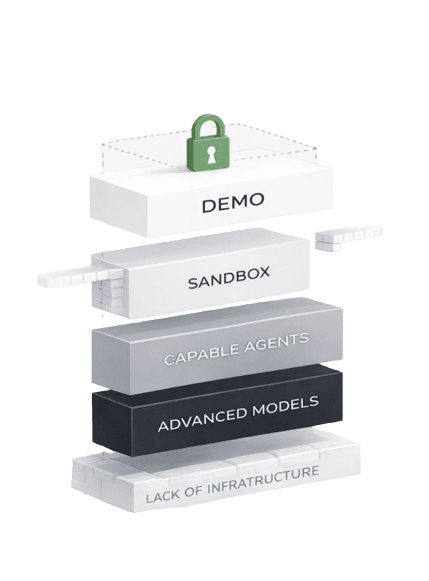
We've entered an era where AI can write code, negotiate contracts, and execute complex multi-step tasks autonomously. Yet most of this capability sits locked away in demos and sandboxed environments. The reason isn't intelligence, it's infrastructure.
The models are ready. The agents are capable. What's missing is the connective tissue that allows agents to operate safely, reliably, and at scale in the real world.
This isn't a minor gap. It's the difference between interesting technology and transformative infrastructure.
Why Traditional Software Infrastructure Falls Short
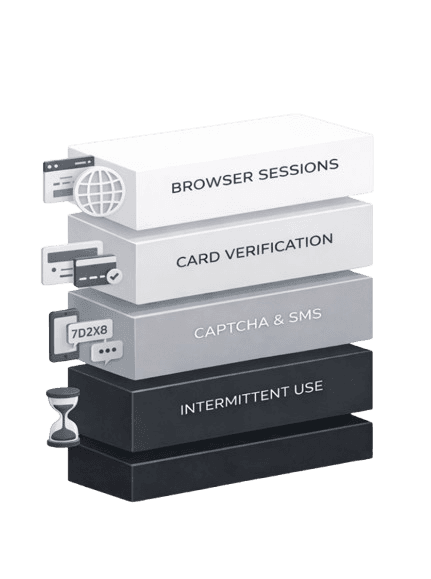
When we built the web, we created infrastructure for humans: authentication systems, payment gateways, API permissions, rate limiting. All of it assumes a human in the loop, someone with a browser session, a credit card, a phone number for 2FA.
Agents break these assumptions entirely.
Consider what happens when an agent needs to:
- Make a payment: Traditional payment rails require user sessions, card verification, and human authorization flows. Agents can't "click confirm" on a Stripe checkout.
- Access an API: OAuth flows expect browser redirects and user consent screens. An agent running in a server process has no browser.
- Prove its identity: CAPTCHA, SMS verification, email confirmation, all designed to prove you're human. Agents fail by design.
- Operate continuously: Session tokens expire. Rate limits kick in. IP addresses get blocked. Infrastructure built for intermittent human use crumbles under continuous agent operation.
We've been trying to fit square agents into round human-shaped holes.
The Five Pillars of Agent Infrastructure
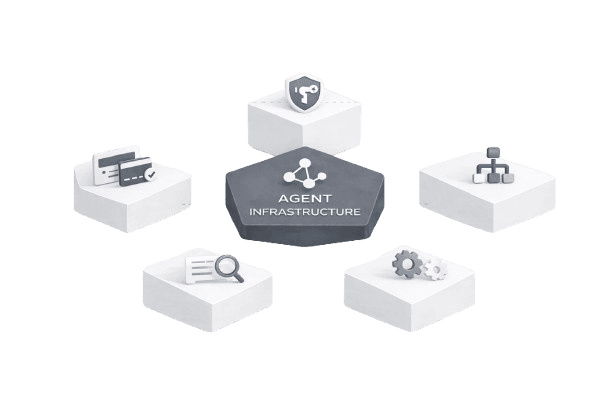
Building infrastructure that actually works for agents requires rethinking several foundational layers:
1. Native Agent Authentication
Agents need authentication mechanisms designed for their reality: long-running processes, programmatic access, and machine-to-machine communication.
This means:
- Cryptographic identity instead of username/password
- API keys with fine-grained scopes instead of session tokens
- Certificate-based authentication that doesn't expire during a task
- Delegation chains that link agent actions back to authorizing humans
The agent doesn't "log in" like a user. It presents credentials that prove what it is, who deployed it, and what it's authorized to do.
2. Agent-Native Payment Rails
Financial infrastructure for agents can't rely on human checkout flows. Agents need:
- Programmatic payment authorization: Pre-approved spending limits with cryptographic enforcement
- Microtransaction support: Many agent tasks involve small, frequent payments that traditional rails can't handle efficiently
- Real-time settlement: Agents operate at machine speed; payment confirmation should match
- Audit trails: Every payment linked to specific agent actions and authorizing principals
Protocols like x402 are emerging to solve exactly this: payment authorization that agents can execute without human intervention, while maintaining full accountability.
3. Structured Permission Systems
Human permissions are coarse: admin or user, read or write. Agent permissions need granularity:
- Task-scoped authorization: "This agent can query customer orders, but only for the next 4 hours, and only for order IDs it receives from the support ticket system"
- Spending caps: "This agent can spend up to $50 per transaction and $500 per day"
- Resource boundaries: "This agent can access this database but not that one, these API endpoints but not those"
- Revocable missions: Permissions that can be withdrawn instantly when circumstances change
This isn't just access control. It's a complete authorization language for autonomous systems.
4. Observable and Auditable Operations
When humans use software, they leave obvious traces: browser history, login records, session logs. Agent operations need equally clear observability:
- Action logging: Every agent action recorded with context
- Decision traces: Why did the agent take this action? What information led to this choice?
- State snapshots: What did the agent know at each decision point?
- Anomaly detection: Automatic flagging when agent behavior deviates from expected patterns
This isn't surveillance, it's the foundation for trust. You can't trust what you can't observe.
5. Failure Recovery and Graceful Degradation
Human users handle errors intuitively. Page doesn't load? Refresh. Payment fails? Try again. Agent infrastructure needs explicit failure handling:
- Retry policies: How many times should an agent retry a failed operation? With what backoff?
- Fallback paths: If the primary approach fails, what alternatives exist?
- State recovery: If an agent crashes mid-task, how do we resume without duplicating actions?
- Human escalation: Clear triggers for when an agent should stop and ask for human intervention
Agents that can't handle failure gracefully aren't ready for production.
The Network Effects of Agent Infrastructure
Here's what makes agent infrastructure particularly interesting: it exhibits powerful network effects.
Single-agent deployment is useful but limited. An agent that can only operate within one company's systems can only do so much.
Multi-agent interoperability changes everything. When agents can:
- Verify each other's identity and credentials
- Transact with each other using shared payment protocols
- Exchange information through standardized interfaces
- Build reputation through observable behavior
...you get an economy, not just tools.
This is why infrastructure standards matter so much. The value isn't just in any individual agent, it's in the connections between agents, the trust relationships they can establish, and the transactions they can conduct.
Why Build Now?
Some argue we should wait. Wait for models to improve. Wait for use cases to mature. Wait for "product-market fit" to emerge.
This is a mistake, and here's why:
Infrastructure shapes what gets built. The applications that emerge from any technology depend heavily on what infrastructure exists. The web we have today was shaped by HTTP, DNS, TCP/IP, and the browser. Different infrastructure choices would have produced a different web.
Agent infrastructure is at this formative stage now. The standards, protocols, and patterns we establish will determine what kinds of agents can be built, what they can do, and how they interact.
Early infrastructure becomes default infrastructure. Once patterns get established, they're extremely hard to change. SMTP's design decisions from 1982 still constrain email today. HTTP's stateless nature still shapes web architecture.
The infrastructure patterns we establish for agents now will likely persist for decades. We should build them thoughtfully.
Capability without infrastructure is unrealized capability. GPT-4 can theoretically manage complex workflows. Claude can theoretically coordinate multi-step tasks. But "theoretically" doesn't help anyone.
Real-world agent deployment requires real-world infrastructure. Without it, we have impressive demos and unrealized potential.
What We're Building
Supermission exists to solve the infrastructure problem for agents. Our approach:
Identity first. Every agent needs verifiable identity before it can do anything meaningful. We provide cryptographic identity that works across contexts, with clear accountability chains linking agents to their deployers.
Payments built in. Agents need to transact. We provide payment infrastructure designed for programmatic authorization, microtransactions, and real-time settlement.
Missions over permissions. Instead of giving agents broad access, we scope their authority to specific tasks with clear boundaries, time limits, and spending caps.
Observability by default. Every agent action creates an auditable record. Not as an afterthought, but as a core system property.
Standards over silos. We build on open protocols like x402 and ERC-8004 because the value of agent infrastructure comes from interoperability, not lock-in.
The Road Ahead
Agent infrastructure isn't a solved problem. It's an emerging field with hard technical challenges:
- How do you balance agent autonomy with oversight?
- How do you handle disputes between agents?
- How do you build reputation systems that can't be gamed?
- How do you create permissions that are expressive enough without being unmanageable?
- How do you maintain privacy while enabling accountability?
These questions don't have obvious answers. They require experimentation, iteration, and learning from real-world deployment.
But that's exactly why this work matters. Someone has to build the roads before cars become useful. Someone has to lay the rails before trains can run.
For agents, someone has to build the infrastructure. We think that time is now.
The Infrastructure Imperative
The agent revolution isn't primarily a model problem anymore. It's an infrastructure problem.
The models will keep improving, that's practically guaranteed. But whether we can actually use those improved models in the real world, for real tasks, with real stakes, that depends entirely on whether the infrastructure exists to support them.
This is why agents need to be developed. Not just as individual applications, but as an ecosystem. Not just with better prompts, but with better infrastructure. Not just for demos, but for production.
The future of AI isn't just about intelligence. It's about the systems that let intelligence operate in the world. And those systems need to be built.
The infrastructure exists. The protocols are live. The only question is who builds on them first. Perhaps that's you. Perhaps that's exactly the point.