
The Rise of Anonymous Agents
Something strange is happening in AI. We're building increasingly capable autonomous systems, agents that can browse the web, execute code, manage finances, and interact with other services on our behalf. Yet we're doing this without solving a fundamental question: who is this agent, and who is responsible for what it does?
The AI industry has been so focused on making agents smarter that we've neglected to make them accountable. We've built systems that can pass the Turing test but can't pass a basic identity check.
This isn't a theoretical problem. It's happening right now.
How Agents Quietly Became a Risk
Consider what today's AI agents can already do:
- Browse websites and fill out forms
- Execute financial transactions
- Send emails and messages
- Access APIs and external services
- Write and deploy code
- Interact with smart contracts
Now consider what we don't know about most agents:
- Who created them
- What permissions they actually have
- What they've done in the past
- Whether they're the same agent they claim to be
- Who bears responsibility when things go wrong
We've essentially created digital entities with increasing capabilities but no persistent identity, no reputation, and no accountability chain. It's like giving someone the keys to your house without knowing their name.
The Very Start Excuse
The common response to these concerns is: "We're still early. Let's figure out identity later once agents are more capable."
This is backwards.
Identity isn't a feature you bolt on after the fact. It's foundational infrastructure that determines how agents can safely operate in the world. Building capable agents without identity infrastructure is like building the internet without DNS, technically possible, but practically unusable at scale.
The longer we wait, the more we entrench patterns of anonymous, unaccountable agent behavior. Every agent framework, every deployment pattern, every integration built today without identity creates technical debt we'll eventually have to repay.
The Identity Foundation
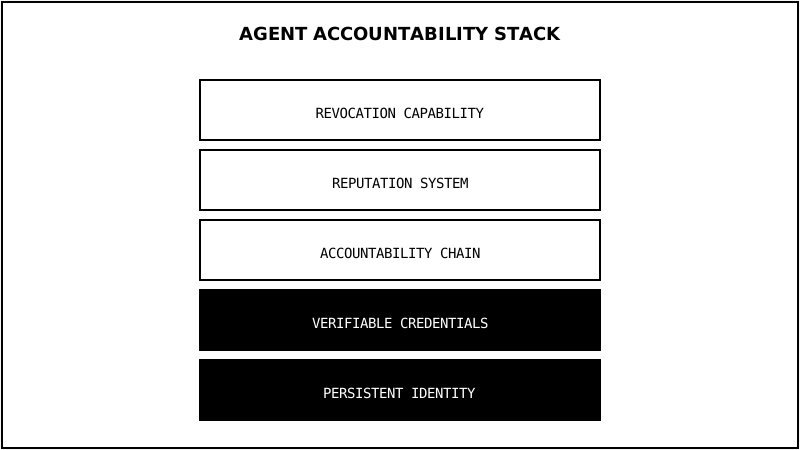
What does proper agent identity look like? It requires several interlocking components:
Persistent Identity: An agent needs a stable identifier that persists across sessions, contexts, and even infrastructure changes. This isn't just a database ID, it's a cryptographic identity that the agent controls and can prove ownership of.
Verifiable Credentials: Anyone interacting with an agent should be able to verify claims about that agent: who created it, what permissions it has, what certifications it holds, what its track record looks like.
Accountability Chain: When an agent acts, there should be a clear chain of responsibility. If an agent makes a purchase, both the agent and its principal (the human or organization that deployed it) should be identifiable.
Reputation System: Agents need to build reputation over time based on their actual behavior. Not just star ratings, but cryptographically verifiable records of past actions and outcomes.
Revocation Capability: When an agent misbehaves or is compromised, there needs to be a way to revoke its credentials and propagate that revocation across all systems it interacts with.
The Question That Actually Matters
Before asking "how smart can we make this agent?" we should be asking "how can we verify what this agent is and hold it accountable?"
This isn't about limiting agent capabilities. It's about creating the trust infrastructure that enables agents to do more, with appropriate oversight.
Think about human institutions. We don't let anonymous people manage money, sign contracts, or access sensitive systems. We require identity verification, background checks, credentials, and accountability structures. Not because we distrust everyone, but because trust at scale requires these mechanisms.
Agents need the same infrastructure. Not because we distrust AI, but because trust in AI systems requires it.
The Infrastructure Shift
Three emerging standards are laying the groundwork for agent identity:
ERC-8004: Agent Registry
ERC-8004 proposes an on-chain registry for AI agents. Each agent gets a unique identifier linked to:
- Its creator/operator
- Its capabilities and permissions
- Its operational history
- Its current status (active, suspended, revoked)
This creates a single source of truth for agent identity that's transparent, immutable, and globally accessible.
x402: Agent Payment Protocol
The x402 protocol enables agents to make and receive payments with built-in identity verification. Every transaction includes:
- Cryptographic proof of agent identity
- Verification of spending permissions
- Audit trail linking payment to agent and principal
This solves a critical piece of the accountability puzzle: financial responsibility.
Mission-Based Authorization
Instead of giving agents broad permissions, mission-based systems scope agent authority to specific tasks:
- Agent X can spend up to $50 on office supplies
- Agent Y can query this database but not modify it
- Agent Z can send emails but only to approved recipients
Missions are time-bounded, revocable, and auditable.
Supermission: The Agentic Layer
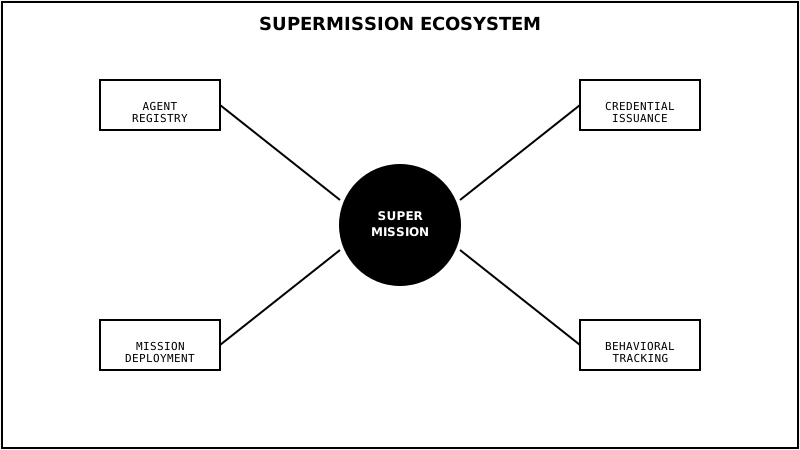
Supermission brings these pieces together into a coherent identity layer for agents. Here's how it works:
Agent Registration: Every agent gets a cryptographic identity anchored on-chain. This identity is controlled by the agent but linked to its principal (creator/operator).
Credential Issuance: Agents receive verifiable credentials for their capabilities, permissions, and certifications. These credentials can be checked by any service the agent interacts with.
Mission Deployment: Instead of giving agents open-ended permissions, principals deploy agents with specific missions that scope their authority.
Behavioral Tracking: Agent actions are logged and can contribute to on-chain reputation. Good actors build trust; bad actors face consequences.
Cross-Platform Verification: Any service can verify an agent's identity and credentials through standard protocols, creating a web of trust across the agent ecosystem.
How It Works Today
Here's a concrete example of agent identity in action:
1. A company creates an AI agent to handle customer support inquiries 2. The agent is registered with Supermission, receiving a unique identity 3. The agent receives credentials: "Authorized to handle support for Company X" and "Can issue refunds up to $100" 4. When the agent interacts with payment systems, those systems verify its credentials 5. Every action is logged. If the agent issues a refund, there's a record linking that action to the agent, its credentials, and its principal 6. If the agent misbehaves, its credentials can be revoked, immediately blocking further actions
This isn't hypothetical. This infrastructure exists today.
The Bigger Vision
Agent identity enables a future that's currently impossible:
Trustworthy Agent Marketplaces: Imagine browsing agents like apps, but with verifiable credentials, track records, and accountability guarantees. You'd know exactly what you're deploying and who's responsible.
Agent-to-Agent Commerce: Agents could transact with each other autonomously because they can verify each other's identity and reputation. No more trust assumptions.
Graduated Autonomy: Agents could earn increased permissions over time based on demonstrated good behavior. Start with limited scope, expand as trust builds.
Insurance and Liability: With clear identity and accountability chains, it becomes possible to insure agent behavior and establish clear liability for failures.
Regulatory Compliance: Regulators increasingly want to know who's responsible for AI systems. Agent identity provides the audit trail and accountability they need.
The Coming SDK and CLI
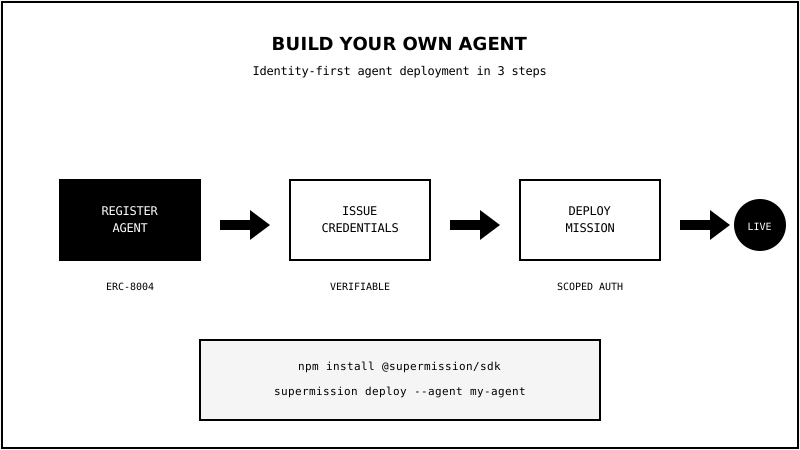
We're building developer tools to make agent identity as easy as authentication:
- A CLI for registering agents and managing credentials
- An SDK for integrating identity verification into any agent framework
- Standard protocols for cross-platform verification
- Dashboard for monitoring agent activity and reputation
The goal is simple: identity should be one import statement, not a months-long infrastructure project.
Why This Matters Now
The window for getting agent identity right is closing. Every day, more agents are deployed without proper identity infrastructure. These agents are establishing patterns, technical and social, that will be hard to reverse.
We're at a similar inflection point to the early web. Back then, the question was whether the internet would have built-in identity or be fundamentally anonymous. We chose anonymity by default, and spent decades building identity layers on top. We're still dealing with the consequences: phishing, fraud, impersonation, and spam.
With agents, we have a chance to make a different choice. Not anonymity by default, but accountability by design.
What Is Actually Changing
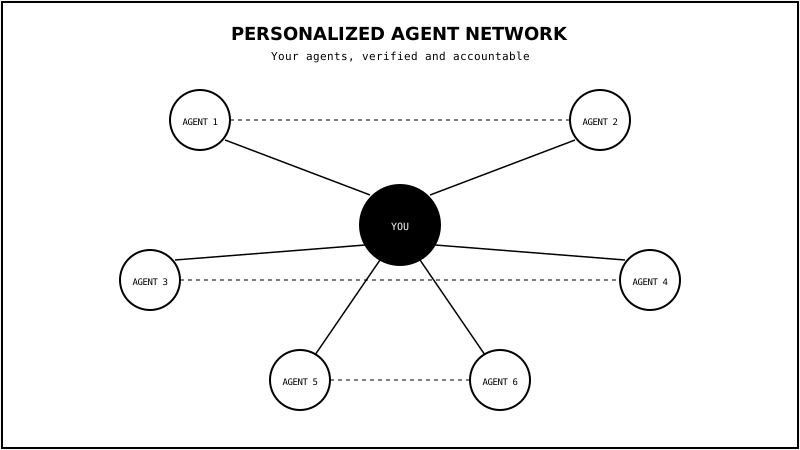
The shift we're proposing isn't about adding bureaucracy to AI. It's about creating the foundation for agents to be genuinely useful at scale.
Without identity, agents are toys, useful for demos and controlled environments, but not for real-world deployment with real stakes. With identity, agents become economic actors that can be trusted, verified, and held accountable.
This is the difference between AI as a research curiosity and AI as fundamental infrastructure for how the world works.
The Real Agent Problem
We've been told the agent problem is making AI smarter. That's not the problem.
The real agent problem is making AI accountable. It's creating systems where agents can be trusted not because we hope they'll behave, but because we can verify their identity, track their actions, and enforce consequences.
Intelligence without accountability is dangerous. Accountability without intelligence is useless. We need both, and we need to build them together, not hope the second one emerges after we've solved the first.
The future of AI agents isn't just about capability. It's about trust. And trust starts with identity.
A secret waits for those who stay. The agents are watching, but who watches the agents? Perhaps you do. Perhaps that's exactly the point.